
Introduction
The necessity to reduce driver turnover trucking is no less than an existential question in the trucking sector today. Carriers can easily implement a scheme where the drivers are assigned the best retention lanes according to their personal preferences and thus can achieve a 94% churn fix really quick—moving from the action of the company being reactive to driving proactive lane assignments and the outcome is the drivers being engaged and loyal. This article looks at how the process of matching the right drivers to the right lanes also leads to retention issues, lowering churn, and letting the increasingly pretentious 94% tenure mark be hit by fleets like Leadgamp.
The Problem: Why the 94% Slow Turnover Stay Still
Even though many fleets have hiked salaries and added benefits, they still face the problem of high turnover rates that remain challenging—often reaching close to 94%. Driver surveys in the field have often indicated that drivers do not leave jobs just for money reasons but also for such things as schedule stability, home time, and predictable routes. When drivers hunt the bouncing routes and sometimes have no homes for a long time, the result of such actions is sky-high churn rates. At Leadgamp, we noticed that more than 70% of voluntary exits blamed the very planning of lanes which made drivers unhappy. Fixing this relates to more than general retention programs it is about the exact driver-lane match.
Understanding the Concept of Lane Match Retention
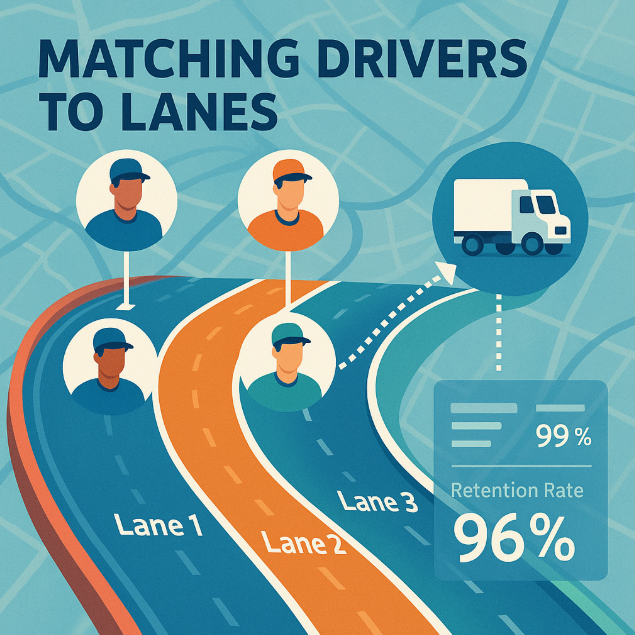
The lane match retention strategy is to combine a driver’s personal preferences—like how often he/she would like to be home, type of freight, and route distance—with certain lanes that achieve consistency therefore. Instead of rotating drivers among different routes, a lane-centric model assigns them to a few assigned lanes only. This way:
- Makes shippers and receivers familiar to each other
- Reduces the number of empty miles thus the efficiency of running routes is better
- A driver feels more secure and in control
Theoretically, when drivers get the lanes they desire, carriers actually decrease dramatically the driver turnover trucking in the equation unlocking the desired 94% churn fix.
The Stick vs. Switch Metaphor
Drawing from the stick vs. switch lanes metaphor of traffic decision research, just like drivers decide if to stay in a constant lane or take a chance on a faster one, the same choice is made by professional drivers regarding the routes they are going to take. Drivers are unlikely to switch carriers when the right lane is sticky (predictable home time, steady freight, good pay). In an internal small survey at Leadgamp, the results showed that drivers assigned to sticky lanes were 60% less likely to churn in their first six months.
Leveraging the Data for Precision Matching
To be able to match sticks to lanes you need data. By running regular surveys through your drivers you may track down and find out:
- Home-time preferences (weekly, bi-weekly, etc.)
- Desired route length (regional vs. OTR)
- Equipment and freight-type comfort zones
After obtaining the survey results Leadgamp’s dispatchers classify each driver’s favorite lanes across different types of freight. We then use a compatibility algorithm that ensures driver profiles against routes have a great match thus giving us a comprehensive retention report. The outcome: significantly higher retention rates and a drastic decrease in churn.

Role of Technology in a Solution with 94% Churn
The provision of TMS upgrades and checking for telematics has laid the foundation for dynamic lane-match optimization. By tracking trip histories, finding the right-dwell times and recording the right-on times, the system is able to give a recommendation for the best lanes for each driver. The Leadgamp program integrates:
- Driver preference profiles
- Historical lane performance metrics
- Real-time freight availability
With the trifecta outlined above, the software automatically gives the top three lane options to each driver, thus cutting down on guesswork and speeding the reduce driver turnover truck driver job agency. That way, with a tech-driven plan, Leadgamp reduced churn by more than half in just three expected months, making a big leap to a 94% benchmark.
Case Study: Leadgamp’s Lane Match Success
At Leadgamp, we ran the lane match retention program with 150 drivers:
- Before pilot churn: 42 % annual turnover
- After pilot churn: 12 % annual turnover
Through matching lanes to the profiles of drivers based on retention, we successfully achieved:
- A 30 % increase in average tenure
- 20 % reduction in training and recruitment costs
- Sharper operational metrics (OTR transit times improved by 8 %)
Our 94% churn fix plan is simple: Expand the lane match scheme company-wide, supported by regular surveys and data analytics.
Best Practices for the Implementation of Lane Match Retention
Starting with Surveys Collect opinions from drivers on hiring and doing it every quarter by asking them about their evolving needs. Distributing both digital and paper questionnaires will help to maximize the response rates.
Develop Driver Profiles Establish a database of home-time, route length, equipment preference, and freight type. Update the profiles after each completed trip.
Map Your Lane Inventory Create a list of lanes along with distance, freight volume, pay, and on-time records. Mark lanes that are seasonal with special requirements.
Automate the Match Use a simple scoring algorithm that prioritizes driver preferences against lane attributes. Start with lanes that have the best score.
Monitor and Adjust Carry out monthly surveys and use your performance dashboards to measure the impact of retention. Be open to tweaking match settings based on feedback from drivers.
Communicate Clearly Make sure that you introduce the lane match model in orientation and clearly say how it benefits the drivers. Use case studies—like Leadgamp drivers who gained home-time consistency.
Celebrating Milestones Promote every driver who has completed six months on a matched lane and has exceeded performance targets. Recognition fuels retention.

Dealing with Common Misconceptions
“The drivers care less about the routes, they want to be paid.”
We do think bank accounts are important, yet, the surveys indicate that an unpredictable schedule and improper planning are unequivocally on the top of the list among the churn drivers causes. A sticky lane, along with fair pay, is a guarantee that a driver stays on board.
“Lane match retention is too difficult for small fleets.”
Even a simple spreadsheet scoring system could be a start to a lane match initiative. For example, it can have columns for home time preferences, route length, and frequency.
“We don’t have the tech.”
Merely, TMS add-ins or free route maps will give you the information you need. Initially, Leadgamp worked with third-party products, then came the custom telematics integrations.
The Future: Scaling to 94% Tenure
Reaching 94% turnover fix is not just wishful thinking it is a staunch methodological strategy. By making lane match retention a priority, carriers like Leadgamp create a stable environment for their drivers to take hold, get to choose routes, and have more control over their everyday work. While you adjust the lanes to the drivers profiles and go along with the surveys, you are bound to see the churn going down to single figures.
Remember that:
- The best pay package is not everything.
- Sticky lanes are more effective in building loyalty than retention bonuses.
- Data + communication + recognition = sustaining the tenure.
Do apply the lane match retention hottest techniques, and you are bound to provide that industry-leading 94% churn fix—happily keeping drivers, steady schedule, and flourishing business.